

media coverage
I. Overview of Reverse Osmosis Pretreatment Processes
Reverse Osmosis (RO), as the core technology for advanced desalination and high-quality water production, has become a standard solution in industrial water treatment and seawater desalination. Despite its high performance, an RO system is extremely sensitive to feed water quality. Even trace levels of suspended solids, colloids, organics, or scaling ions can lead to membrane fouling and performance decline.
RO pretreatment acts as the first and most critical line of defense, ensuring safe, stable, and long-term operation. Its effectiveness directly determines whether an RO system can operate reliably, efficiently, and economically.
01. Groundwater Pretreatment: Iron & Manganese Removal and Softening as the Core
1) Typical Characteristics of Groundwater
Groundwater is often regarded as a high-quality feed water due to its stable composition and low turbidity. However, it typically contains significant levels of dissolved ferrous iron (Fe²⁺) and manganese (Mn²⁺).
2) Key Challenges for RO Systems
Iron/manganese fouling and scaling caused by hardness and alkalinity are the primary threats to RO membrane performance and lifespan.
3) Recommended Pretreatment Process for Groundwater
Raw Water: Aeration / Oxidation→Multimedia Filtration→Softener→Cartridge (Security) Filter→RO System
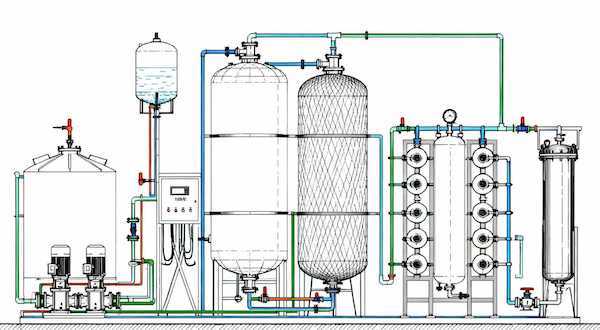
4) Process Breakdown
Oxidation - Oxidation converts dissolved iron and manganese into insoluble precipitates, creating conditions for effective removal by filtration.
Filtration - Multimedia filters efficiently remove oxidized precipitates and fine particles, reducing particulate loading on downstream units.
Softening - Ion-exchange softeners remove calcium and magnesium ions, effectively preventing calcium carbonate and sulfate scaling in RO membranes.
Security Filtration - A 5 μm cartridge filter acts as the final safeguard before RO, intercepting any residual particles.
5) Critical Control Parameters
Proper control of ORP, hardness, and SDI is essential to ensure long-term stable RO operation.
02. Surface Water Pretreatment: Turbidity Removal & Microbial Control as the Key Focus
1) Typical Characteristics of Surface Water
Surface water quality fluctuates significantly due to seasonal changes, rainfall, and upstream activities. It typically contains high turbidity, abundant colloids, organic matter, and active microorganisms.
2) Key Challenges for RO Systems
Organic fouling and biofouling are the most critical issues when treating surface water, often leading to rapid membrane fouling and shortened service life.
3) Recommended Pretreatment Process for Surface Water
Raw Water: Coagulation / Flocculation→Clarification or Dissolved Air Flotation (DAF)→Multimedia Filtration→Activated Carbon Filtration→UV Disinfection→Cartridge Filter→RO System
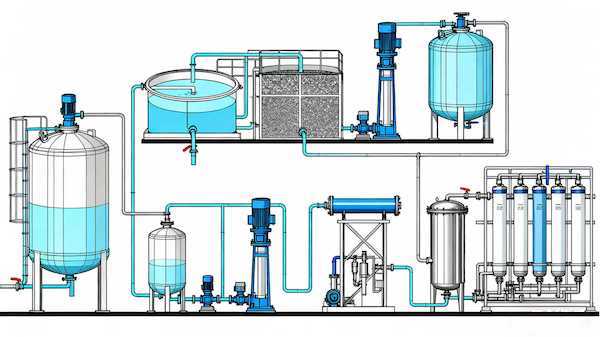
4) Process Breakdown
Coagulation & Flocculation - Coagulants destabilize colloidal particles and form settleable flocs, laying the foundation for effective downstream treatment.
Clarification / DAF - Clarification or DAF removes the majority of suspended solids and flocs, significantly reducing turbidity.
Activated Carbon Adsorption - Activated carbon adsorbs organic compounds and residual chlorine, protecting RO membranes from oxidation and organic fouling.
UV Disinfection - Effective control of coagulation, SDI, and activated carbon maintenance is essential for long-term RO system stability.
5) Key Control Points
Coagulation Performance: Optimal coagulant dosage shall be determined through jar testing, which is a prerequisite for achieving effective downstream filtration performance.
SDI (Silt Density Index): SDI is a critical performance indicator. The SDI15 of multimedia filter effluent should be maintained below 5, with a target value of less than 3 for stable RO operation.
Activated Carbon Management: Activated carbon filters shall be periodically thermally disinfected or replaced to prevent them from becoming a breeding ground for microorganisms.
03. Seawater Pretreatment: Corrosion Resistance and Scaling Control as the Major Challenges
1) Typical Characteristics of Seawater
Seawater is an extreme feed water characterized by very high salinity (TDS approximately 35,000 mg/L), elevated hardness and sulfate concentrations, and strong corrosive potential.
2) Key Challenges for RO Pretreatment
Extreme scaling potential, biological activity, and corrosion risk are the primary concerns in seawater RO pretreatment.
3) Recommended Pretreatment Process for Seawater
Raw Seawater: Intake Screening (Bar Screen / Strainer)→Coagulation→Media Filtration→Cartridge (Security) Filtration→RO Chemical Dosing→RO System
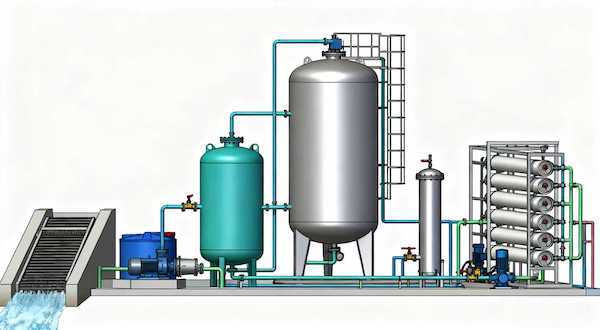
4) Process Breakdown
Intake Screening - Coarse and fine screens at the intake remove large debris and marine organisms, protecting downstream equipment.
Enhanced Coagulation - Coagulant addition destabilizes colloids and fine particles, enhancing the removal efficiency of downstream media filters.
Media Filtration - Media filters provide deep-bed filtration of flocculated particles, reducing turbidity and particulate loading.
Cartridge Filtration - A 5 μm cartridge filter serves as the final barrier, preventing particulate intrusion into RO membranes.
RO Chemical Dosing - Seawater-specific antiscalants and reducing agents are dosed to control scaling and eliminate oxidants, protecting RO membranes.
5) Critical Control Parameters
Strict control of residual chlorine, appropriate antiscalant selection, and close monitoring of filter differential pressure are essential for stable seawater RO operation.
04. Cooling Tower Blowdown: Extreme Softening and Integrated Multi - Technology Treatment
1) Typical Water Quality Characteristics
Cooling tower blowdown is a highly concentrated and complex feed water, typically characterized by:
- Elevated TDS due to concentration cycles
- High hardness and alkalinity
- Increased silica concentration
- High levels of organic matter
Blowdown water can be regarded as a “concentrated version” of the circulating cooling water, posing significant challenges to RO pretreatment.
2) Key Challenges for RO Pretreatment
When used as RO feed water, cooling tower blowdown presents the following critical issues:
Severe scaling potential
- High hardness, alkalinity, and silica promote aggressive scale formation
Organic matter and chemical interference
- Residual antiscalant, biocides, and organics interfere with membrane performance and pretreatment efficiency
Effective pretreatment must address both inorganic scaling and organic fouling risks simultaneously.
3) Recommended Pretreatment Process Flow
Raw Blowdown Water: Chemical Softening Clarifier→Media Filtration→Weak Acid Cation (WAC) Exchanger→Decarbonator→Cartridge (Security) Filtration + Antiscalant Dosing→RO System
This integrated process focuses on maximum hardness removal, alkalinity reduction, and comprehensive membrane protection.
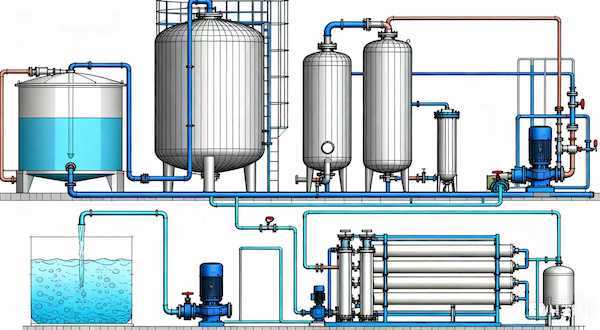
4) Process Breakdown
Chemical Softening - Lime [Ca(OH)₂] and soda ash [Na₂CO₃] are dosed to chemically precipitate calcium, magnesium, and a portion of silica, significantly reducing scaling potential.Chemical softening is the primary step for bulk hardness and silica removal.
Weak Acid Cation Exchange (WAC Softening) - A weak acid cation exchanger provides deep softening, further removing residual hardness associated with alkalinity after chemical softening.The WAC unit enhances overall hardness removal efficiency and stabilizes RO feed water quality.
Decarbonation - A decarbonator tower strips dissolved CO₂ generated during softening, reducing alkalinity and lowering the inorganic carbon load on the RO system.Decarbonation helps prevent downstream pH-related scaling and improves RO performance.
Antiscalant Dosing and Final Filtration - Prior to RO, water passes through a cartridge filter for fine particle removal, while a high-performance antiscalant formulated for high concentration factors is dosed to control residual scaling risks.
5) Critical Control Parameters
pH Control in Chemical Softening→Precise pH control is essential to maximize hardness and silica removal efficiency
Hardness and Alkalinity Monitoring→Continuous monitoring of WAC effluent ensures consistent feed water quality
TOC / COD Monitoring→Organic content must be closely tracked to assess fouling potential and chemical interference
Proper control of these parameters is critical for stable, long-term RO operation when treating cooling tower blowdown.
05. Other Typical Feed Waters: Key Pretreatment Considerations
1) Municipal Wastewater / Reclaimed Water
Key Challenges:
Municipal wastewater and reclaimed water typically contain high levels of organic matter (COD/BOD), nutrients (nitrogen and phosphorus), microorganisms, and residual pharmaceuticals, posing significant risks to RO membranes.
Pretreatment Strategy:
The recommended approach combines biological treatment (e.g., MBR) with advanced oxidation processes (AOPs) and ultrafiltration (UF) to effectively control organic fouling and biofouling.
2) Industrial Wastewater (Electronics / Textile / Pharmaceutical)
Key Challenges:
Industrial wastewater is characterized by complex and highly variable composition, often containing heavy metals, high salinity, and refractory organic compounds, which pose severe risks to RO systems.
Pretreatment Strategy:
Targeted pretreatment combined with UF as a robust barrier is essential to protect RO membranes from irreversible fouling and damage.Regardless of feed water type, pretreatment must ensure that fouling risks are controlled, predictable, and manageable before reaching the RO membranes.
II. Pretreatment Process Selection Guide: The Four-Step Approach
Selecting an appropriate RO pretreatment process for a project requires a systematic decision-making approach. The following four-step methodology provides a practical framework for rapid and reliable process selection.
Step 1: Comprehensive Water Analysis
Obtain a complete water quality analysis report. This serves as the foundation for all subsequent decisions. Avoid relying solely on experience or assumptions.
Step 2: Identify the Primary Challenges
Determine the core contaminants and match them to corresponding pretreatment strategies:
|
Key Water Quality Issue |
Recommended Pretreatment Approach |
|
Hardness / Fe / Mn |
Groundwater-type pretreatment |
|
Turbidity / Colloids / Organics |
Surface water-type pretreatment |
|
High salinity / Corrosivity |
Seawater-type pretreatment |
|
Highly concentrated pollutants |
Cooling tower blowdown-type pretreatment |
Step 3: Select Core Process Units
- Apply “matching unit to contaminant” principles:
- Iron / Manganese removal: Oxidation + Filtration
- Hardness / Silica removal: Softening or Chemical Softening + Ion Exchange
- Turbidity / Colloid removal: Coagulation + Clarification + Multimedia Filtration
- Organics / Residual chlorine removal: Activated Carbon Adsorption
Step 4: Establish the Ultimate Barrier
Conventional choice: Cartridge (Security) Filter
- Low cost, limited protection
Preferred choice: Ultrafiltration (UF)
- Consistently produces water with SDI15< 3
- Reliable solution for complex feed waters
The final barrier is the insurance policy for RO membranes, preventing unexpected fouling and particulate intrusion.
There is no “one-size-fits-all” pretreatment solution. Success depends on:
Deep understanding of feed water characteristics
Precise combination of targeted process units
Remember: Pretreatment is not a cost - it is the longest-lasting protection for your RO system.